Insights
Agency client concentration risk: what losing your largest client costs
Your concentration risk is not your largest client's share of fees. It is the share of your profit that client carries, and the months your cash lasts once it leaves. Work out both for your top three clients, and you know how exposed you really are.
Mohammad Azam, Aprecity Consultants · 5 min read
Why one large client feels safe
Your largest client pays on time, likes the work and renews every year. It feels like your most stable income.
Then a new marketing director arrives, or a budget gets cut. Your team and your rent stay exactly where they were.
Measure the profit it carries
Client's share of profit = (client's fees - its delivery cost) / your total profit
Run the numbers on an invented agency earning $100,000 a month. Its team costs $70,000, overheads $20,000, and it makes $10,000 profit.
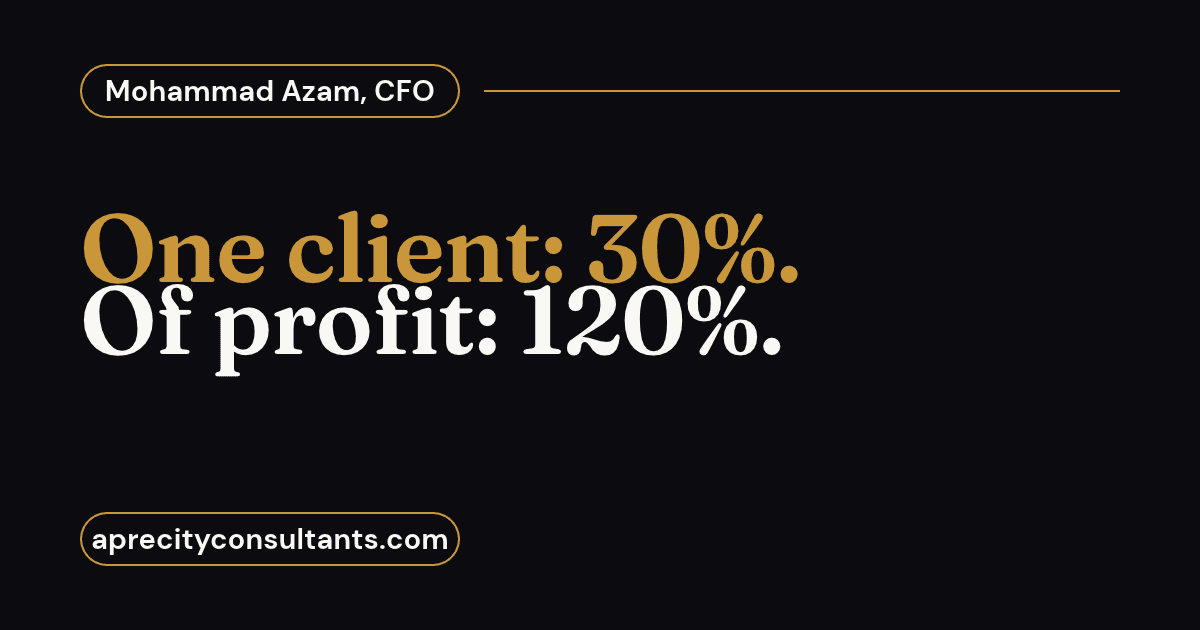
Its largest client pays $30,000 a month, 30% of fees. Delivering that account takes $18,000 of team time.
That leaves $12,000 from one client, against $10,000 of total profit. The other clients, taken together, lose $2,000 a month.
| Line | Before | Team kept | Team cut |
|---|---|---|---|
| Monthly fees | $100,000 | $70,000 | $70,000 |
| Team cost | $70,000 | $70,000 | $52,000 |
| Overheads | $20,000 | $20,000 | $20,000 |
| Monthly result | $10,000 profit | $20,000 loss | $2,000 loss |
These figures describe an invented agency chosen to show the arithmetic. They are not a client result.
Keep the team while you replace the work, and the agency loses $20,000 a month. Even cutting every hour the client used leaves a loss.
Count the months your cash lasts
Months of cover = cash you can spare / monthly loss
With $60,000 of spare cash, the invented agency has three months to win $30,000 of new monthly fees. Winning and onboarding a client that size often takes longer.
Run it on your own numbers
- ( 01 )
List twelve months of fees by client
Rank clients from largest to smallest. Note each one's share of the total.
- ( 02 )
Cost your top three
Multiply the hours each account took by what an hour of your team costs. Subtract from its fees.
- ( 03 )
Compare with your profit
Divide each answer by your monthly profit. Anything near 100% means one client carries the agency.
- ( 04 )
Run the month after
Take the client out, keep every cost, and see the monthly loss. Divide your spare cash by it.
What to do with the answer
If one client carries most of your profit, the rest of your book is underpriced. Fix that first, because it lowers the risk without losing anyone.
Then hold enough spare cash to cover the months it would take to replace your largest client. That figure tells you how fast to grow the others.
Rerun the four steps every quarter. When no single client carries more than its share of profit, losing one becomes a bad month, not a crisis.