Insights
What is the difference between an owner's salary and a distribution?
A salary pays you for the job you do in your agency, and it is a cost. A distribution is a share of the profit left after every cost, paid to you as the owner. Take only distributions and your profit looks larger than it is, by the value of your own work.
Mohammad Azam, Aprecity Consultants · 6 min read
Why the two get mixed up
You own the agency and you work in it. Money reaches you both ways, and at the bank it looks the same.
A salary pays you for the job you do. A distribution pays you for owning the business. One is a cost. The other is a share of profit.
Take everything as distributions and your profit and loss shows no cost for your work. The profit on the page includes your own wages.
What the mix-up costs
You price, hire and plan from that profit figure. If it is overstated, every decision built on it leans too far.
A 20% margin tells you there is room for a hire. Part of that margin is the pay you have not booked for yourself.
Put a salary on your own job
Real profit = profit before owner pay - market salary for the job you do
The market salary is what you would pay someone else to do your job. Think of the work you do each week, not your title.
Run the numbers on a marketing agency with $900,000 of gross income. Its team and overheads cost $720,000, and the owner takes $150,000 a year.
| Line | No salary on the books | With a market salary |
|---|---|---|
| Gross income | $900,000 | $900,000 |
| Team and overheads | $720,000 | $720,000 |
| Owner's salary | $0 | $130,000 |
| Profit | $180,000 | $50,000 |
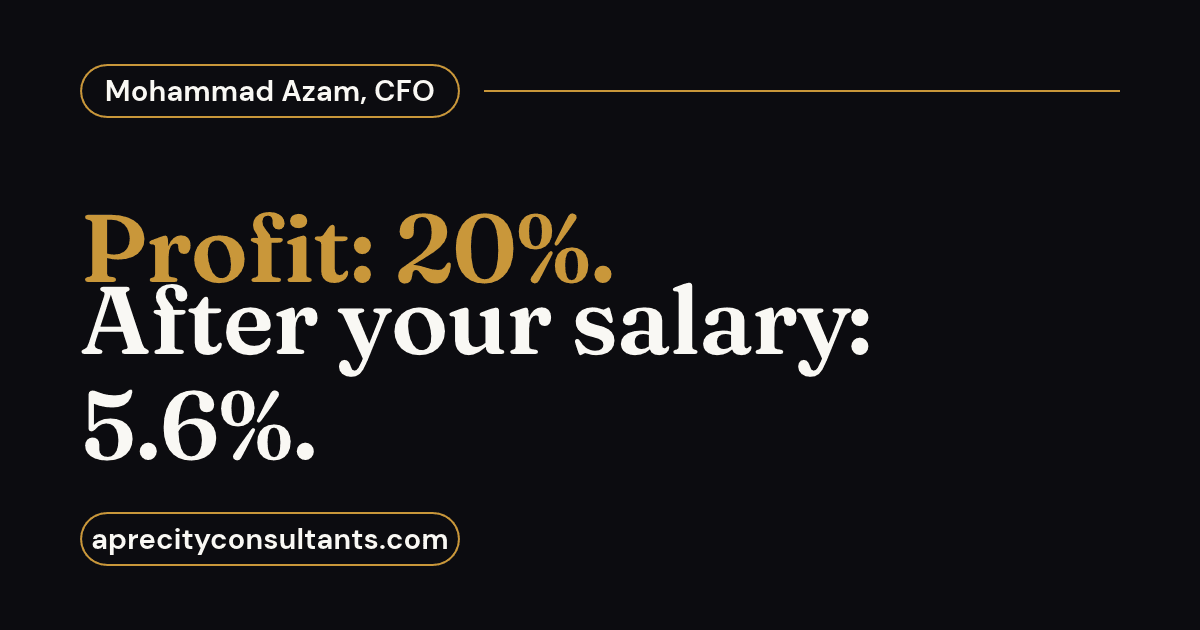
| Profit margin | 20% | 5.6% |
| Distributions taken | $150,000 | $20,000 |
These figures describe a marketing agency chosen to show the arithmetic. They are not a client result.
The owner's take is $150,000 either way. What changes is the profit: $180,000 on the page, $50,000 once the job is paid for.
Of that $150,000, $130,000 is pay for the work. Only $20,000 is a return for owning the agency.
Run it on your own numbers
- ( 01 )
List the work you do
Write down the hours you spend on client work, sales and management in a normal week.
- ( 02 )
Price that job
Decide what you would pay a hire to cover it. Use what you have paid, or been quoted, for similar roles.
- ( 03 )
Find your profit before owner pay
Take last year's profit and add back any salary you already paid yourself.
- ( 04 )
Subtract the market salary
What remains is the profit the agency earns as a business. Divide it by gross income for the real margin.
- ( 05 )
Compare it with what you took out
Anything you drew above your salary plus real profit came out of the agency's cash, not its earnings.
What to do with the answer
Book your market salary as a cost each month, whatever you actually draw. Your margin, prices and hiring plans then rest on a profit that is real.
How each kind of pay is taxed depends on how your business is set up. Ask your tax preparer before you change what you draw.
The number that proves it is real profit. When it stays positive after your salary, the agency pays you twice: once for the job, once for owning it.