Insights
What is the formula for your agency's utilization rate?
Utilization rate is billable hours divided by available hours, as a percentage. The formula is the easy part. What decides whether the number means anything is which hours you count as available, and whether billable hours were actually billed. Here is how to work out yours from one month of timesheets.
Mohammad Azam, Aprecity Consultants · 6 min read
The utilization formula
Your utilization rate is the share of the hours you pay for that go on work a client pays for. It sits behind your hiring decisions and the hourly cost in every quote.
Utilization rate = billable hours / available hours x 100
Available hours are the hours someone is paid for, less vacation, sick days and holidays. Billable hours are the ones spent on client work.
The arithmetic is never where this goes wrong. The definitions are, because the same timesheets can give two very different rates.
Billable is not the same as billed
Hours logged against a client feel billable. Some of them never reach an invoice: the third revision round, the extra report, the call that ran long on a fixed fee.
Count those as billable and your team looks full. You then hire to fix what is really a scoping problem, and add a salary the work does not pay for.
One designer, one month
Run the numbers on one designer in a month with 160 paid hours. One vacation day leaves 152 available. They log 118 hours on client work, and 22 of those sit beyond the scope anyone agreed to pay for.
| What you divide | Hours | Utilization |
|---|---|---|
| Client hours by paid hours | 118 / 160 | 73.8% |
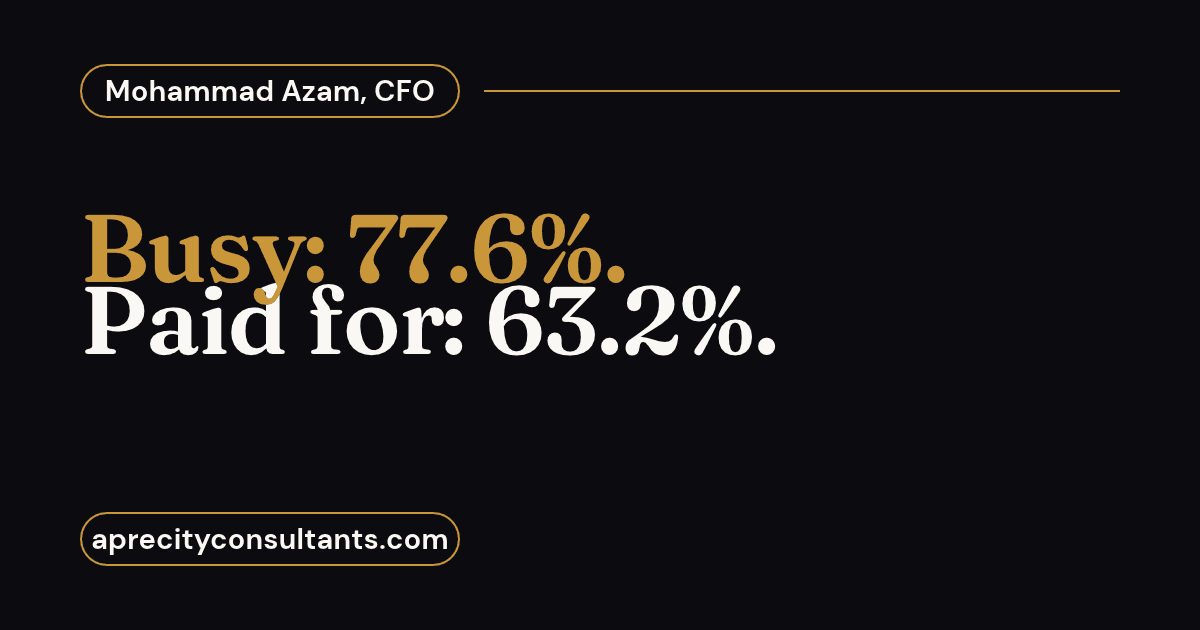
| Client hours by available hours | 118 / 152 | 77.6% |
| Billed hours by available hours | 96 / 152 | 63.2% |
These figures describe an invented month chosen to show the arithmetic. They are not a client result.
The gap between 77.6% and 63.2% is 22 hours of work nobody paid for. At $55 an hour, salary and everything paid on top, that is $1,210 a month from one person, or $14,520 a year.
How to work out your own rates
- ( 01 )
Take one full month
Use the last complete month of timesheets for everyone who does client work, you included.
- ( 02 )
Work out available hours
Start from paid hours. Take out vacation, sick days and holidays.
- ( 03 )
Split client hours in two
Hours inside an agreed scope or invoiced, and hours beyond scope that nobody paid for. Ask the team if the timesheets cannot tell you.
- ( 04 )
Divide both by available hours
Do it per person first, then for the team. A team figure hides the one person absorbing the overruns.
- ( 05 )
Put a cost on the gap
Multiply each person's unbilled client hours by what an hour of their time costs you. That is the monthly price of the gap.
What to do with the answer
There is no target to borrow here. The rate that matters is the one your prices already assume. If your hourly cost assumes the team bills 75% of its hours and it bills 63%, every quote starts too low.
If the billed rate sits well below the client rate, hold off hiring. Fix scoping and change orders first, because those hours are already on your payroll.
If both rates are high and work still slips, the team is genuinely full. A hire then pays for itself, and your timesheets show by how much.
Run it every month. When the billed rate climbs while the client rate holds, your scoping fixes are working. Each point gained is hours you now get paid for.
The service behind this
Fractional CFO
We read your numbers every month and bring you the decision. Profit on each client, a forecast that reaches past the next payroll, and a straight answer on pricing and hiring.
Keep reading
Two more you can run this week
How to calculate your agency's effective hourly rate
Your effective hourly rate is the total fee on an account divided by every hour your team put into it. It is almost always lower than your rate card, and the gap between the two is what scope creep costs you. Here is how to work it out in an afternoon.
The scope creep audit: a 15 minute check on your last three projects
Scope creep does not show up as a line on your P&L. It shows up as a margin that quietly fell and nobody can explain. This audit compares scoped hours against delivered hours on three finished projects, and usually finds the leak in one sitting.
Next step
Found something you cannot explain?
That is the useful outcome. Bring the number to a 20 minute call and we will work out what is behind it.