Insights
At what point does your agency need a CFO?
Your agency needs a CFO's work when the decisions you make without numbers cost more than the work would. That point is set by your decisions, not your revenue. Add up what last year's hires, prices and unbilled work cost you, and compare the total with the cost of finance leadership.
Mohammad Azam, Aprecity Consultants · 6 min read
Why revenue is the wrong trigger
You have heard that a business needs a CFO at a certain size. Your agency is near it, or past it, and nothing feels different.
Size is not what creates the need. Decisions do. You need the work a CFO does when your decisions outrun your numbers.
A bookkeeper tells you what happened last month. A CFO's work tells you what a hire, a price or a new client will do next.
What deciding without numbers costs
Each decision made on instinct has a price. You rarely see it, because it never appears as a line in your accounts.
Cost of deciding blind = sum of what each decision cost that your numbers would have changed
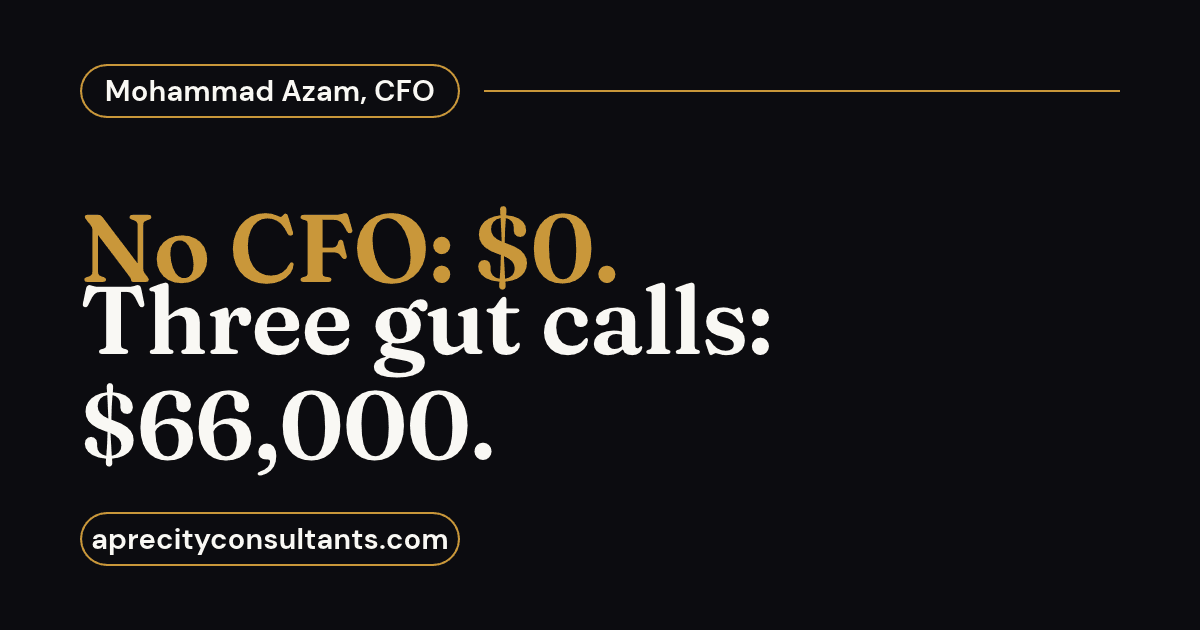
Run the numbers on a creative agency and three decisions from its last twelve months.
| Decision | What happened | Cost |
|---|---|---|
| Hired a strategist on a hunch | Fees to cover the role arrived four months late | $30,000 |
| Renewed a retainer at the old price | Work ran $1,500 a month over the fee for twelve months | $18,000 |
| Let extra requests go unbilled | $2,000 a month of work for nine months | $18,000 |
| Total | Three decisions | $66,000 |
These figures describe a creative agency chosen to show the arithmetic. They are not a client result.
The hire cost $7,500 a month for four months before the fees arrived. None of the three decisions felt like a mistake at the time.
The signs you are at that point
- You set prices from what other agencies charge, not from what the work costs you.
- You cannot say which clients make money after the hours they take.
- You hire when the team feels stretched, and check the bank balance afterward.
- Your profit and your cash disagree, and you cannot explain the gap.
- A lender, a buyer or a large client asks for figures you cannot produce in a week.
Run it on your own numbers
- ( 01 )
List last year's large decisions
Write down every hire, price change, new retainer and large purchase from the last twelve months.
- ( 02 )
Mark the ones made on instinct
Tick each decision you made without a forecast, a margin or a cash figure in front of you.
- ( 03 )
Price what each one cost
Count the months of cost before fees arrived, the work done over the fee, and the hours never billed.
- ( 04 )
Add them up
The total is what deciding blind cost you in one year.
- ( 05 )
Compare it with the cost of the work
Set the total against a quote for part-time finance leadership. You do not need a full-time CFO to get a CFO's work.
What to do with the answer
If the total is small, you are not there yet. Clean books and a monthly close will carry you.
If the total is larger than the cost of the work, you are past the point. Every month you wait adds to it.
The number that proves it is the total itself. Run it again in a year, and it should be a fraction of what it was.