Insights
How many billable hours should each person at your agency log?
Each person should bill enough hours to cover what they cost you, their share of overhead and your margin. Price those hours at the rate you really earn, not your rate card. That number comes from your own costs and prices, not a benchmark. Here is the formula and a worked example for one designer.
Mohammad Azam, Aprecity Consultants · 6 min read
Why a borrowed target misleads you
You set a billable target so you know whether each person pays for themselves. Most targets are a round number someone repeated, with no link to what that person costs.
Set it too low and a fully booked team still loses money. Set it too high and you hire too late, while good people burn out.
The billable hours formula
The hours someone needs to bill come from four numbers you already have. Those are what they cost, their share of overhead, the margin you want and what you really earn per hour.
Billable hours needed = (yearly cost + share of overhead) / (1 - target margin) / effective hourly rate
Divide by one minus the margin, never add the margin on top. Adding 20% to cost gives you a 16.7% margin, not 20%.
The effective hourly rate is your fee divided by every hour the work really took. On fixed fees and retainers it sits below the rate card.
One designer, one year
Run the numbers on one designer. Their salary and everything paid on top come to $72,000 a year. Their share of rent, software and admin is $24,000.
You want a 20% margin, and their work earns an effective $85 an hour across fixed fees and retainers. They have 1,920 available hours after vacation and holidays.
| Step | Arithmetic | Result |
|---|---|---|
| Cost to cover | $72,000 + $24,000 | $96,000 |
| Fee needed for a 20% margin | $96,000 / 0.8 | $120,000 |
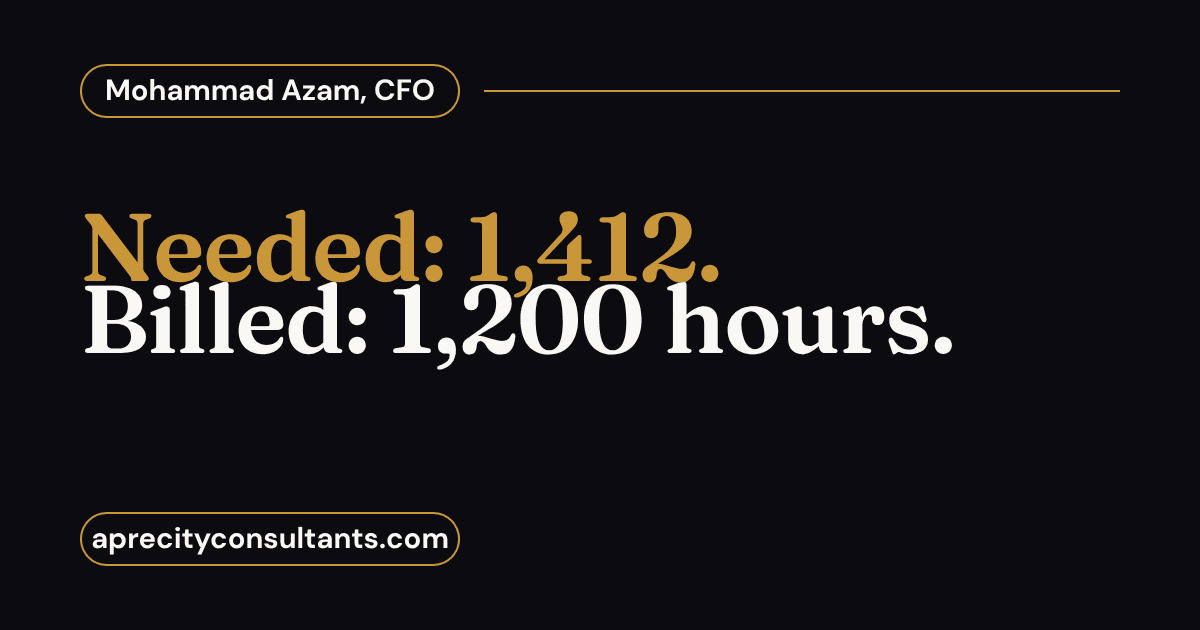
| Billable hours needed | $120,000 / $85 | 1,412 hours |
| Utilization your price assumes | 1,412 / 1,920 | 73.5% |
These figures describe an invented designer chosen to show the arithmetic. They are not a client result.
Now say the designer bills 1,200 hours, which feels like a busy year. The fee comes to $102,000. After $96,000 of cost, the margin is 5.9%, not 20%.
The 212 hours in between are worth $18,020 a year from one person.
How to work out your own targets
- ( 01 )
Total each person's yearly cost
Salary, payroll taxes, benefits and anything else that follows them, such as their software seats.
- ( 02 )
Give each a share of overhead
Add up rent, tools, admin and your own time away from clients. Split it across everyone who does client work.
- ( 03 )
Divide by one minus your margin
For a 20% margin, divide by 0.8. For 30%, divide by 0.7.
- ( 04 )
Divide by your effective hourly rate
Use what you really earn per hour on that person's accounts, not the rate card.
- ( 05 )
Compare with available hours
Divide the result by their available hours. That is the utilization your prices quietly assume.
What to do with the number
If the hours needed exceed the hours available, no amount of effort closes the gap. The price is wrong, so raise the rate or cut the scope.
If the target is reachable but the team bills less, look at unbilled overruns before you hire. Those hours are already on your payroll.
Set targets per role from this arithmetic, and rerun it when a salary or a price changes. Each extra billed hour at $85 goes straight to profit, because the cost is already paid.