Insights
How do you calculate an overhead rate for your agency?
To calculate your agency's overhead rate, divide a year of overheads by the billable hours worked in that year. The answer is what every billable hour must carry before it earns a profit. Add it to each person's direct hourly cost, or your margin is overstated on every quote.
Mohammad Azam, Aprecity Consultants · 6 min read
Why your hourly cost is higher than payroll says
You know what each person costs you. You divide their pay by the hours they bill and price above that figure. The job still earns less than you planned.
The missing piece is overhead. Rent, software, insurance and the pay of people who never bill a client all have to be carried by billable hours.
The formula
Overhead rate = yearly overheads / yearly billable hours
Overheads are every cost you cannot tag to one client. The answer is a dollar amount that each billable hour must carry before it earns anything.
Some firms state it as a percentage of direct labor cost instead. Both use the same overheads. The hourly form is easier to price with.
Run the numbers
Take a creative agency with $240,000 of yearly overheads and 12,000 billable hours a year. Its overhead rate is $20 an hour.
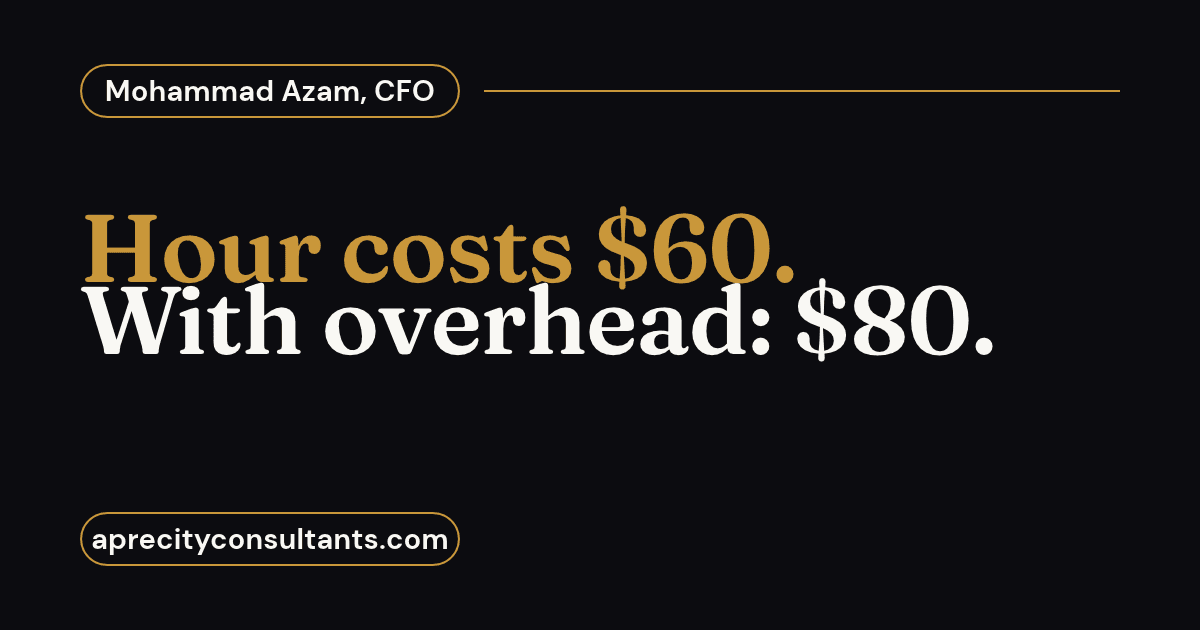
A designer costs $84,000 a year with payroll taxes and benefits, and bills 1,400 hours. That is $60 an hour before overhead. The creative agency charges $100.
| Line | Amount | Share of rate |
|---|---|---|
| Rate charged | $100 | 100% |
| Designer's direct cost | $60 | 60% |
| Margin before overhead | $40 | 40% |
| Overhead rate | $20 | 20% |
| Margin after overhead | $20 | 20% |
These figures describe a creative agency chosen to show the arithmetic. They are not a client result.
The 40% margin on the quote is a 20% margin in the bank. Half of it was never profit.
What moves your overhead rate
Two things move it: the overheads themselves and the hours that carry them. The hours move faster.
If the creative agency's billable hours fall to 10,000, the rate rises to $24 with no new cost. Every hour priced on the old rate loses $4.
That is why a quiet quarter hurts twice. You bill fewer hours, and each hour you do bill carries more.
Run it on your own numbers
- ( 01 )
Total twelve months of overheads
Add rent, software, insurance, professional fees, marketing and the pay of anyone who does not bill clients.
- ( 02 )
Leave out client costs
Media, freelancers hired for one job and other costs tagged to a client are not overhead. Keep them with the client.
- ( 03 )
Total your billable hours
Use the hours logged against clients over the same twelve months, not the hours you hoped to bill.
- ( 04 )
Divide the two
That is your overhead rate. Add it to each person's direct hourly cost to get their full cost.
- ( 05 )
Check your rates against it
Any rate below full cost loses money on every hour. Any rate just above it leaves no profit.
What to do with the answer
Price every quote and change order on full cost, not on pay alone. Recalculate the rate each quarter, because hours shift faster than rent.
When your books tag every cost as client or overhead, the rate takes minutes to produce. Then the margin on your quote matches the one you keep.